Members

Household Ledger
budget and accounts, local on your machine
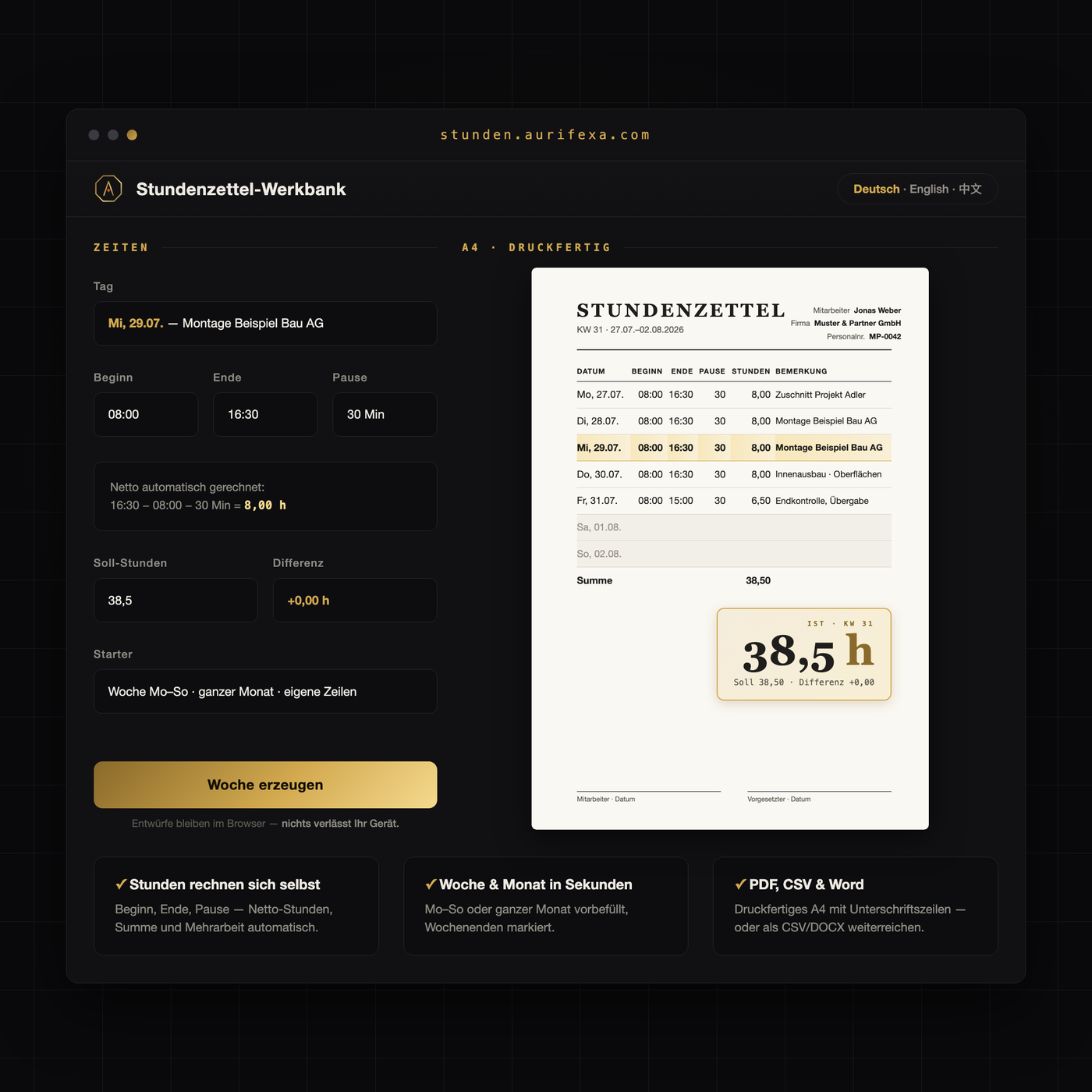
Month-end comes and the timesheets are missing — nobody remembers when the break was. Excel mis-rounds the quarter hours, and the client wants a clean statement.
The Timesheet Workbench adds up start, end and break by itself — out comes a signature-ready timesheet.
An AURIFEXA original — designed and built in our own studio.
This tool is free. Create an account — no payment details — and download right away.
| Platform | Browser |
|---|---|
| Price | Free — registration is all it takes |
If you work in Germany, you will sooner or later meet the word Stundenzettel — a timesheet recording when you started, when you finished and how long your breaks lasted. What used to be a habit of construction sites and shift work has become a much broader topic: the European Court of Justice ruled that employers must have a system in place to record their employees' daily working time, and German courts have followed that line. The legislative details are still being worked out, but the direction is clear — working hours are expected to be documented, not estimated. For overtime and certain types of employment, German law has required records for years.
Reliable records protect both sides. Employees can prove overtime when it matters, employers can settle questions about extra hours and breaks with facts instead of memories, and self-employed professionals simply have no solid basis for an hourly invoice without them.
A usable Stundenzettel answers three questions: who worked when, how long the breaks were, and what the totals are. In practice it should contain:
Two habits make the record trustworthy: fill it in promptly rather than reconstructing the month from memory, and record breaks honestly — long days without any documented break raise questions rather than looking diligent.
This is exactly where improvised solutions fail. Paper notes get lost or contradict each other, and spreadsheets miscalculate as soon as times are entered as text or quarter hours need rounding. At the end of the month, someone recalculates everything by hand.
If you bill clients by the hour, the timesheet is not an internal document — it is part of the business relationship. German clients expect to see what they are paying for: day by day, with clear times and no room for interpretation. A clean, consistent timesheet speeds up approval because there is nothing to argue about, and a countersigned one is solid backing if questions about the invoice come up later. The usual routine is to attach the timesheet to the invoice or have the client sign it off beforehand; the more consistent it looks from month to month, the faster that routine runs.
The Stundenzettel-Werkbank by AURIFEXA takes over the error-prone arithmetic. You enter start, end and break — the tool adds up the times itself, day by day and across the whole period. No broken formulas, no rounding errors, no late-night recalculation.
The result is a signature-ready timesheet, print-ready as a PDF: attach it to your invoice, hand it to your client for countersigning, or keep it for your records. The tool is free to use after registration.
Note: This information does not constitute legal advice.
German case law, following a ruling by the European Court of Justice, assumes that employers must systematically record their employees' working time. For overtime and certain types of employment, record-keeping duties have existed for years. The legislative details are still evolving, so reliable day-by-day records are the safe course either way. This is general information, not legal advice.
Stundenzettel is the German word for a timesheet: a record of when you started work, when you finished and how long your breaks were, usually with daily and monthly totals. In Germany it commonly carries signature fields, because having the timesheet countersigned — by the employer or by the client — is standard practice.
A complete timesheet lists the person's name, the date of each working day, start and end times, breaks with their duration, and the daily and period totals. Where relevant, it also names the project or client and provides signature fields for both sides, so the record can be confirmed and attached to an invoice.
The usual routine is a timesheet per billing period: start, end, break and total for each day, plus project and period. Freelancers attach it to the invoice or have the client sign it off beforehand. A clean record that looks the same every month speeds up approval and prevents discussions about individual items later.
Yes. The Stundenzettel-Werkbank is a free tool by AURIFEXA, available after free registration. You enter start, end and break times; the tool adds everything up automatically, day by day and for the whole period, and produces a signature-ready timesheet as a print-ready PDF — suitable for billing clients as well as for your own records.
