Members

Household Ledger
budget and accounts, local on your machine
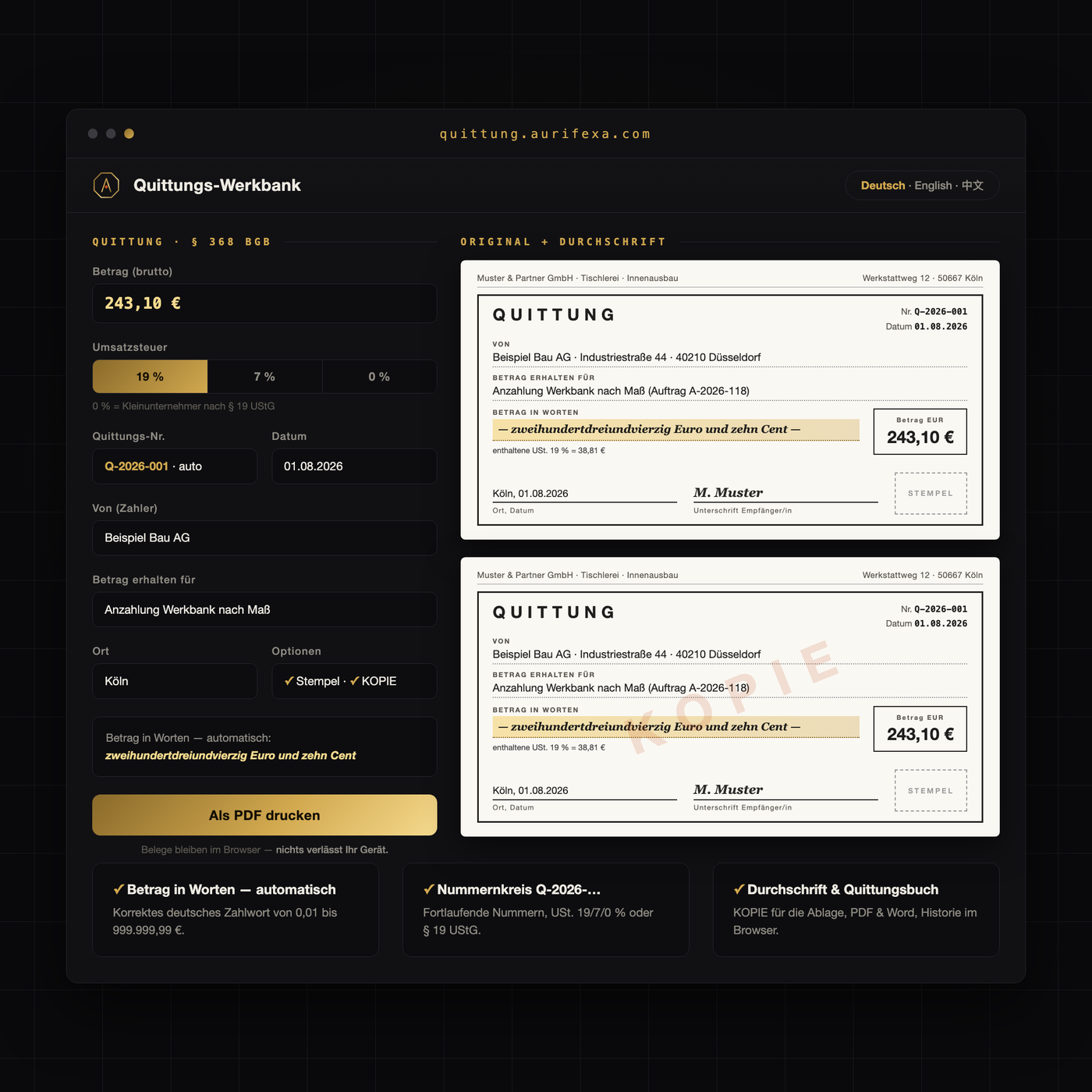
"Could you write me a receipt?" — and the pad is empty again. Handwritten slips look unprofessional, and the amount in words is a guaranteed typo.
The Receipt Workbench writes it cleanly — amount in words generated automatically, error-free.
An AURIFEXA original — designed and built in our own studio.
This tool is free. Create an account — no payment details — and download right away.
| Platform | Browser |
|---|---|
| Price | Free — registration is all it takes |
German paperwork distinguishes sharply between two documents that English speakers tend to lump together as "the receipt". A Rechnung is an invoice: it demands payment, lists what was delivered and what is owed, and comes before the money moves. A Quittung is a receipt in the narrow sense: it confirms that money has actually been received, and comes after payment. German civil law explicitly entitles the person paying to such a written confirmation — if you hand over cash, you may ask for a Quittung. Keep the two apart in practice: a Quittung does not replace a proper invoice, which carries its own mandatory contents, especially in business and tax contexts. For payments between private individuals, however, the Quittung is often the only paper trail that will ever exist — which is exactly why it should be done properly.
For the receipt to do its job as evidence, it should contain:
A practical habit worth copying: make the receipt in duplicate, one copy for each side, and keep it for as long as the underlying matter can still have consequences. For a rental deposit, that means until the deposit has been fully returned after moving out.
The doubled amount — once in figures, once spelled out — is fraud protection, not folklore. Digits are easy to alter: a single stroke turns a 1 into a 4, an added zero multiplies the sum by ten. A number written out in words is almost impossible to change without it showing, and any mismatch between figures and words is immediately visible. The catch for anyone whose first language is not German: German number words are long, compound and unforgiving — exactly the part of the document most likely to go wrong when written by hand.
Cash still plays a bigger role in Germany than in most neighbouring countries, and money between private people often changes hands without any contract: the second-hand purchase arranged on a classifieds platform, the rental deposit (Kaution) handed over in cash, a loan among friends. If a dispute arises later — "I never received that money" — it is one word against another. A signed Quittung ends that discussion before it starts; it takes half a minute at the handover and can save weeks of argument.
The Quittungs-Werkbank removes the part most likely to go wrong: you enter the details, and the tool writes the amount out in correct German words automatically and without errors — no wrestling with compound number words, no crossed-out corrections. The result is a cleanly written, professional-looking receipt instead of a scribbled note. The tool is free to use after registration.
Note: This information does not constitute legal advice.
A Quittung is a receipt: written confirmation that a payment has actually been received. It is distinct from a Rechnung, which is an invoice demanding payment. German civil law entitles the payer to such a confirmation, so whenever you hand over cash — for a deposit, a second-hand purchase or a private loan — you may ask for one.
It is protection against tampering. Digits are easy to alter — an added zero multiplies the sum by ten — while a number spelled out in words can hardly be changed without leaving traces. Any mismatch between figures and words is spotted immediately. The Quittungs-Werkbank generates the German number words automatically and without spelling errors.
Name the payer and the recipient with addresses, state what the payment was for, give the amount in figures and in words, add place and date, and have the person receiving the money sign. Make two copies, one for each side. The Quittungs-Werkbank assembles exactly this document after free registration.
Generally yes — no particular form is prescribed. What matters is complete content: both parties, purpose, amount in figures and in words, place, date and the recipient's signature. In practice, though, a cleanly printed receipt looks more credible and avoids the spelling mistakes that easily creep into handwritten German number words.
Yes, and you should. Ask the landlord for a Quittung stating the purpose — deposit (Kaution) for the specific flat — the amount in figures and words, the date, and the landlord's signature. Keep it until the deposit has been fully returned after you move out; it is your main proof the money was ever handed over.
