Members

Household Ledger
budget and accounts, local on your machine
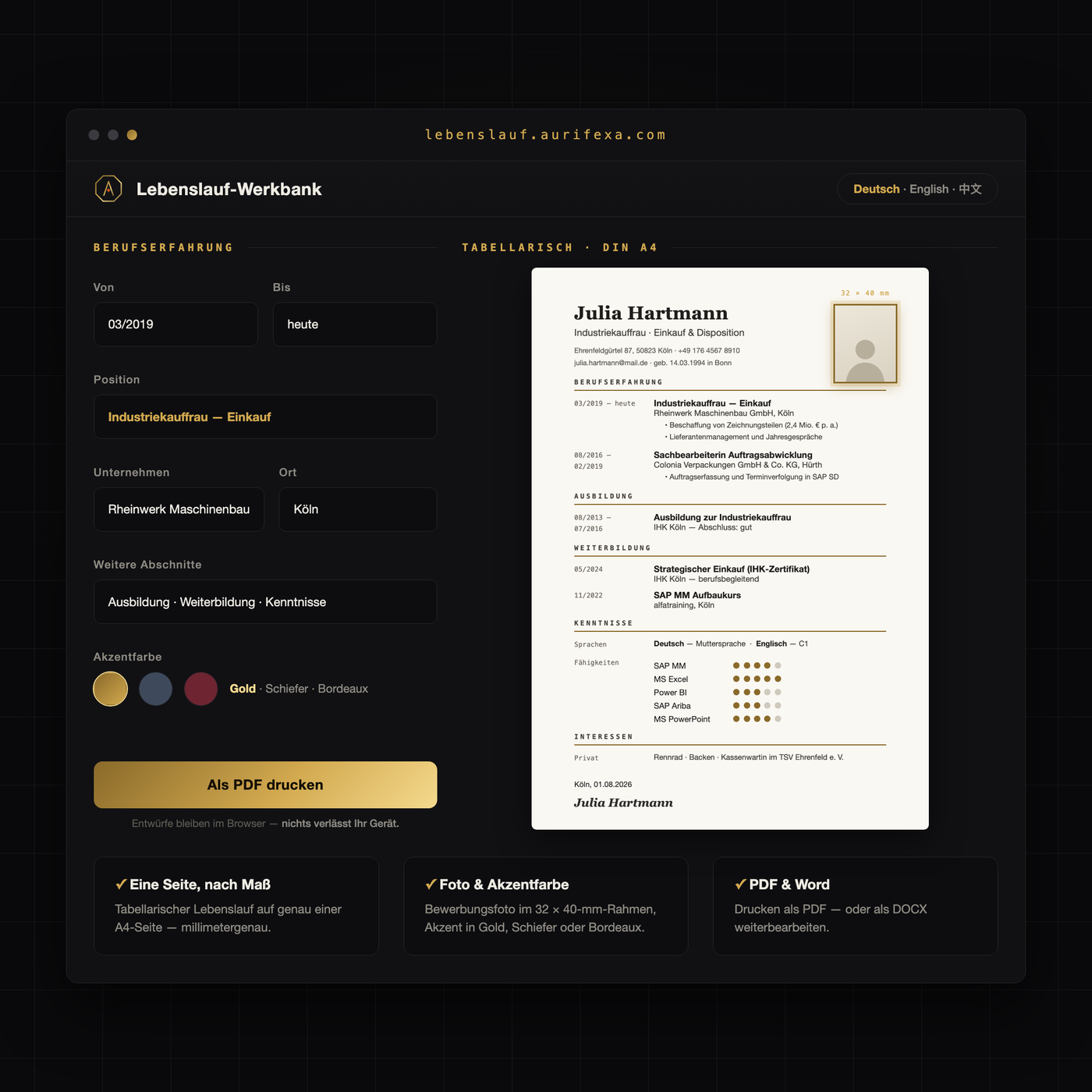
The application has to go out today — but the Word template wrecks the layout with every new entry. The photo slips, columns jump, the CV spills onto page two.
The CV Workbench builds the German tabular CV on exactly one A4 page — fields on the left, the finished sheet on the right.
An AURIFEXA original — designed and built in our own studio.
This tool is free. Create an account — no payment details — and download right away.
| Platform | Browser |
|---|---|
| Price | Free — registration is all it takes |
If you are applying for jobs in Germany, the most important thing to know is that employers here expect a specific document: the tabellarischer Lebenslauf, literally a “tabular CV”. It is not a narrative resume. It is a structured overview, usually in two columns — dates on the left, positions on the right — that a recruiter can scan in seconds.
The conventional sections are:
Within each section, reverse chronological order is the standard: your current or most recent position comes first. Starting with primary school and working forward is considered outdated.
Applicants from the US or UK are often surprised that German CVs traditionally carry a professional headshot. The situation today: under the General Equal Treatment Act (AGG), no employer may require a photo, and applying without one is entirely acceptable. In practice, a good photo is still common in many industries. If you use one, treat it as an investment — neutral background, proper lighting, business attire. A cropped holiday picture does more harm than no picture at all.
Another German habit is adding place, date, and a handwritten signature at the bottom of the CV. This is convention rather than obligation; it signals that the information is current and given in earnest.
For most applications, one A4 page is the benchmark; two pages are defensible only after a long career with many relevant positions. Treat the limit as an editing tool: recent, relevant roles get detail, older ones get compressed. German recruiters scan quickly, and a tight single page is more likely to be read in full.
Recruiters here also read timelines carefully, so unexplained gaps stand out. The good news for internationals: relocating to Germany, intensive language study, and recognition procedures for foreign qualifications are legitimate entries — name them instead of leaving blank space. The same goes for further training, family time, or caring for a relative. An honestly labelled gap reads as composure; a discovered one reads as concealment. Keep one date format throughout, and make sure periods neither overlap nor silently disappear.
The most common practical failure has nothing to do with content: word-processor templates collapse. One extra entry and the photo slips; one longer job title and the columns jump; in the end the text spills onto page two — on exactly the day the application has to go out.
The Lebenslauf-Werkbank by AURIFEXA works with a fixed grid instead. You fill in clearly labelled fields, and the tool builds the finished sheet: a German-style tabular CV on exactly one A4 page. Because the layout is locked, new entries cannot push anything around — no drifting photo, no jumping columns, no overflow onto a second page. The tool is free to use after registration, which leaves your effort where it belongs: on choosing and phrasing the right entries, not on fighting the formatting.
It is the standard German CV format: a structured, usually two-column overview with dates on the left and positions on the right, instead of narrative text. Typical sections are personal details, work experience, education, and skills, each in reverse chronological order. For most applications it should fit on a single A4 page with a consistent, gap-free timeline.
No. Under the General Equal Treatment Act (AGG), employers may not require a photo, and applications without one are fully acceptable. In practice, a professional headshot is still common in many industries and rarely hurts. If you include one, invest in quality: neutral background, good lighting, a recent picture — never a casual snapshot.
One A4 page is the benchmark, especially for early-career applicants. Two pages are acceptable after a long career with many relevant positions; more is considered excessive. Use the limit as a filter: describe recent, relevant roles in more detail and compress older ones. German recruiters scan quickly, and a tight single page tends to get read completely.
Short transitions of a few weeks need no explanation. Name longer gaps openly: further training, family time, caring for a relative, relocating to Germany, or intensive language study are all legitimate entries. German recruiters read timelines closely, and an unexplained gap raises more questions than an honest one. Keep date formats consistent and avoid overlapping periods.
Yes, it is free to use after registration. You enter your details into fixed, labelled fields, and the tool builds a German-style tabular CV on exactly one A4 page. Because the layout is locked, new entries cannot shift the photo or columns — the formatting problems of word-processor templates simply do not occur.
