Members

Household Ledger
budget and accounts, local on your machine
The letter has to go out today — and Word just shifted the address field again. The window envelope doesn't line up, the fold marks are missing, and the dunning letter sounds either too soft or too harsh.
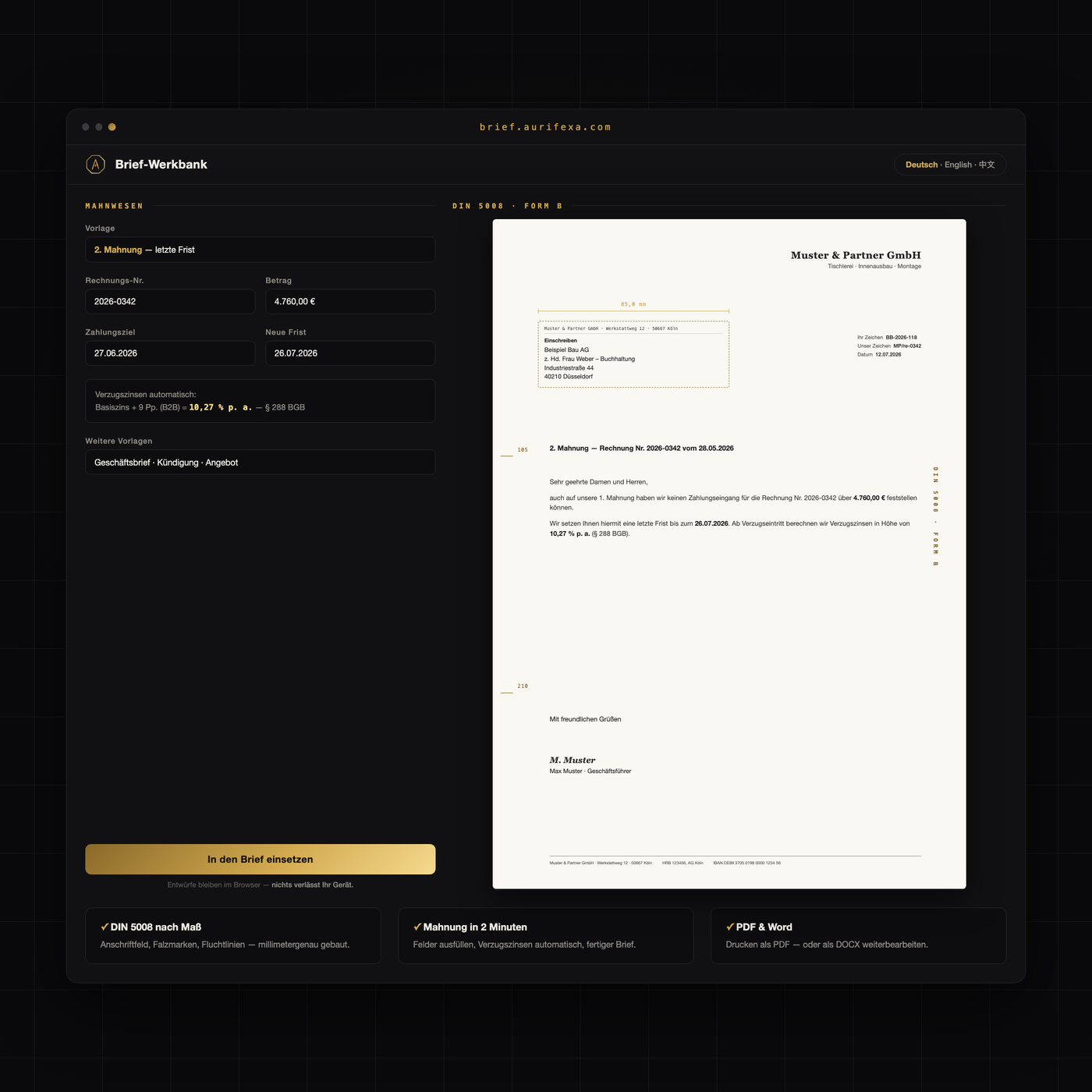
The Letter Workbench builds your business letter to DIN 5008 — millimetre-accurate, in the browser. Fields on the left, the finished letter on the right. What you see is the PDF.
An AURIFEXA original — designed and built in our own studio.
This tool is free. Create an account — no payment details — and download right away.
| Platform | Browser |
|---|---|
| Price | Free — registration is all it takes |
Anyone writing to a German company, landlord, insurer, or authority will eventually meet DIN 5008 — the standard that defines how a formal letter is laid out, down to the millimeter. It is not a legal requirement for private correspondence, but it is the format German recipients expect, and a letter that follows it reads as professional before a single sentence is understood. In the widely used Form B layout, the address field (Anschriftfeld) begins 45 millimeters from the top edge of the page and is 85 millimeters wide. A small zone above the address holds delivery remarks such as Einschreiben (registered mail). To the right sits the information block (Informationsblock) with contact person, phone, e-mail, reference numbers, and the date. Fold marks (Falzmarken) on the left edge — 105 and 210 millimeters from the top in Form B — show where to fold the sheet so the address lands exactly in the envelope window. Rebuilding these measurements by hand in a word processor rarely survives the first line break.
A Mahnung is a formal payment reminder — and German business culture has a well-established etiquette for it. The usual sequence starts with a friendly Zahlungserinnerung (payment reminder) that assumes an oversight, followed by one or two Mahnungen with an increasingly firm tone. Legally, under the German Civil Code (BGB), a single clear reminder can be enough to put a debtor in default; the multi-stage ritual is commercial courtesy, not an obligation.
What matters is precision: invoice number, invoice date, outstanding amount, the original due date, and a new deadline with a concrete calendar date. Vague phrases like as soon as possible carry no weight because they have no verifiable end. The tone stays factual at every stage — no threats in the first reminder, no apologies in the last.
German offices mail A4 letters in window envelopes, most commonly DL (110 × 220 mm) and C6/5 (114 × 229 mm). The sheet is folded in thirds at the fold marks, and the recipient's address shows through the window — which only works when the address field sits precisely where DIN 5008 puts it. A few millimeters off, and the sender line drifts into the window or the postal code is cut off, which can slow down machine sorting or, in the worst case, bounce the letter. And you only find out after printing, when fixing it costs the most time.
The Brief-Werkbank builds your business letter to DIN 5008 directly in the browser — millimeter-precise. You fill in fields on the left, and the finished letter appears on the right. Address field, information block, and fold marks are locked to their standard positions and cannot shift, no matter how long your text runs; there are no tab stops or text frames to wrestle with. Payment reminders take shape on the same grid, with a tone that is neither too soft nor too blunt. The folded result fits any DL or C6/5 window envelope, with the address sitting squarely in the window. After free registration, the tool is free to use.
Note: This information does not constitute legal advice.
DIN 5008 is the German standard for formatting business letters and documents. It defines margins, the address field position, fold marks, and the information block in millimeters. It is not legally mandatory for private letters, but German companies, landlords, and authorities expect it, and a correctly formatted letter is taken more seriously. The Brief-Werkbank applies the standard automatically.
A Mahnung is a formal payment reminder sent when an invoice remains unpaid. German practice usually escalates in stages: a friendly Zahlungserinnerung first, then one or two firmer Mahnungen. Under German civil law, a single clear reminder can be enough to put the debtor in default. Each letter should state the invoice number, the amount, and a concrete new deadline.
Fold the A4 sheet in thirds at the DIN 5008 fold marks so the address field appears in the window of a DL (110 × 220 mm) or C6/5 (114 × 229 mm) envelope. If the letter follows the standard layout, the recipient's address lines up exactly with the window. The Brief-Werkbank places the fold marks in the correct positions for you.
Formal correspondence with German companies, landlords, and authorities is normally expected in German, and a letter in the correct DIN 5008 layout signals that you understand local conventions. Many staff read English, but replies and processing are usually faster with a German letter. The Brief-Werkbank gives you the correct German layout; the wording you enter is up to you.
Yes. The Brief-Werkbank is a free tool by AURIFEXA that runs in the browser, with no installation. After free registration you can build business letters and payment reminders to DIN 5008: you fill in fields on the left and see the finished, correctly measured letter on the right, ready for a window envelope.
