Members

Household Ledger
budget and accounts, local on your machine
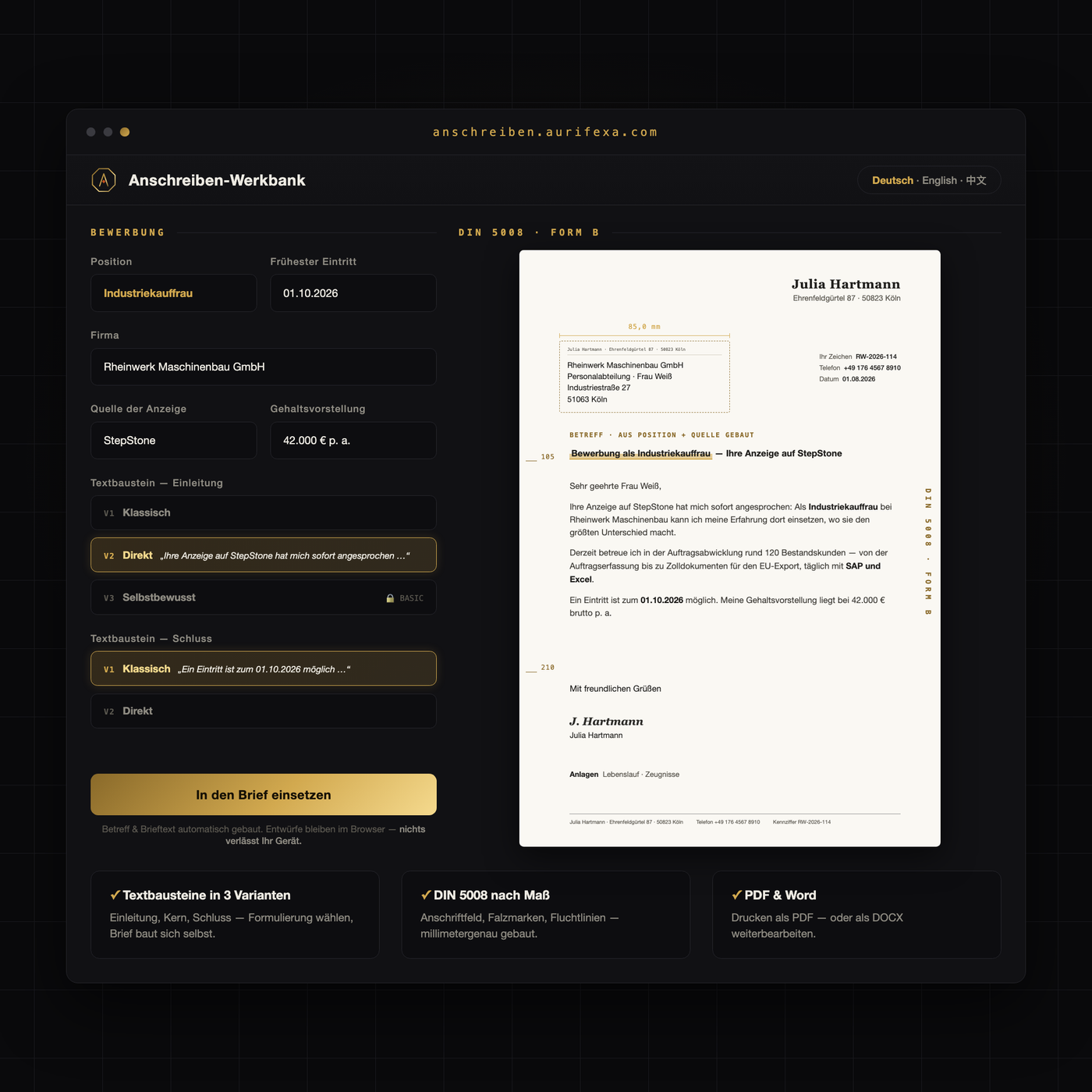
The CV is done — but the cover letter feels like a blank page. Every sentence takes ten minutes, and the layout still misses the envelope window.
The Cover Letter Workbench builds your application letter to DIN 5008 — with phrasing blocks that do not sound canned.
An AURIFEXA original — designed and built in our own studio.
This tool is free. Create an account — no payment details — and download right away.
| Platform | Browser |
|---|---|
| Price | Free — registration is all it takes |
A traditional German job application consists of two parts: the CV (Lebenslauf) and the cover letter, called the Anschreiben. In many countries the cover letter has become optional; in Germany, plenty of employers still read it carefully — as the place where you connect your experience to their specific role, and as a sample of how you communicate in writing. For non-native speakers it is the hardest part of the application: the conventions are rigid, and the stock phrases that templates offer tend to sound exactly like what they are.
The length convention is firm: one page. Recruiters read many applications, and a letter that makes its case on a single page reads as more confident than two pages of self-description. Cut whatever merely repeats the CV — the Anschreiben complements it, it does not summarize it.
The layout convention is DIN 5008, the German standard for business letters. It defines where the address block sits — positioned so the address shows through the classic German window envelope (Fensterkuvert) — along with the placement of date and subject line, margins and spacing. It is not legally required for applications, but it is the silent default: a letter that follows DIN 5008 looks orderly to German readers without any extra effort, while a letter that ignores it stands out in the wrong way.
The most common weakness in German cover letters is not grammar but empty sentences. "Ich bin teamfähig, flexibel und belastbar" (I am a team player, flexible and resilient) is a list of claims without evidence; "Mit großem Interesse habe ich Ihre Anzeige gelesen" (I read your posting with great interest) says nothing at all. The working rule: every sentence needs either information or evidence — anything that provides neither can go.
The Anschreiben-Werkbank by AURIFEXA addresses both weak points, form and phrasing. It builds the letter in the correct DIN 5008 layout, with the address block where it belongs, so the finished letter fits the window envelope. And instead of a blank page, you work with German text modules deliberately designed not to sound like boilerplate: they provide the structure of a sentence, while the specifics — the role, your experience, your evidence — come from you. The result stays personal, which matters most when you are applying in a second language. The tool is free to use after registration.
In most cases, yes. A German application traditionally consists of a CV (Lebenslauf) and a cover letter (Anschreiben), and many employers still expect both unless the posting says otherwise. The Anschreiben is where you connect your experience to the specific role — German recruiters also read it as a sample of how you work and communicate.
DIN 5008 is the German standard for formatting business letters: it defines where the address block, date and subject line sit, and which margins and spacing to use. It is not legally required for job applications, but it is the silent default — a letter that follows it looks orderly to German readers and fits the classic window envelope.
One page is the firm convention. Recruiters read many applications, and a letter that makes its case on a single page comes across as more confident than two pages of self-description. Cut anything that merely repeats your CV — the Anschreiben is meant to complement it with motivation and evidence, not to summarize it.
Four parts have proven effective: a concrete opening that refers to the specific role, a short passage on your motivation, a core section matching two or three requirements from the job ad with evidence from your experience, and a confident closing with your availability. Formally, the letter carries an address block, date and subject line.
Yes. The Anschreiben-Werkbank is a free tool by AURIFEXA, available after free registration. It lays out your cover letter according to DIN 5008 so the address block sits correctly for a window envelope, and offers German text modules that provide sentence structure without sounding like boilerplate — you fill in the specifics of role and experience.
